Why Data Quality is the Silent Risk in Pharma Serialization
The report said 100% compliance. The reality was different. When we did a physical audit, we found serialized cartons with duplicate serial numbers, aggregation records that didn't match the physical hierarchy, and SSCC codes that existed in the system but not on any pallet. The system was working. The data wasn't.
Why data quality is invisible until it isn't
Serialization systems are designed to process events at speed. They are not designed to question the quality of what they are processing. A serial number gets commissioned, an aggregation gets recorded, an EPCIS event gets sent, all green, all compliant on paper.
The problem surfaces later. During a regulatory inspection. During a product recall. During a market withdrawal where you need to trace every unit and the data doesn't hold up.
By then, it's too late to fix the root cause. You're in damage control mode.
Three data quality failures I've seen in production
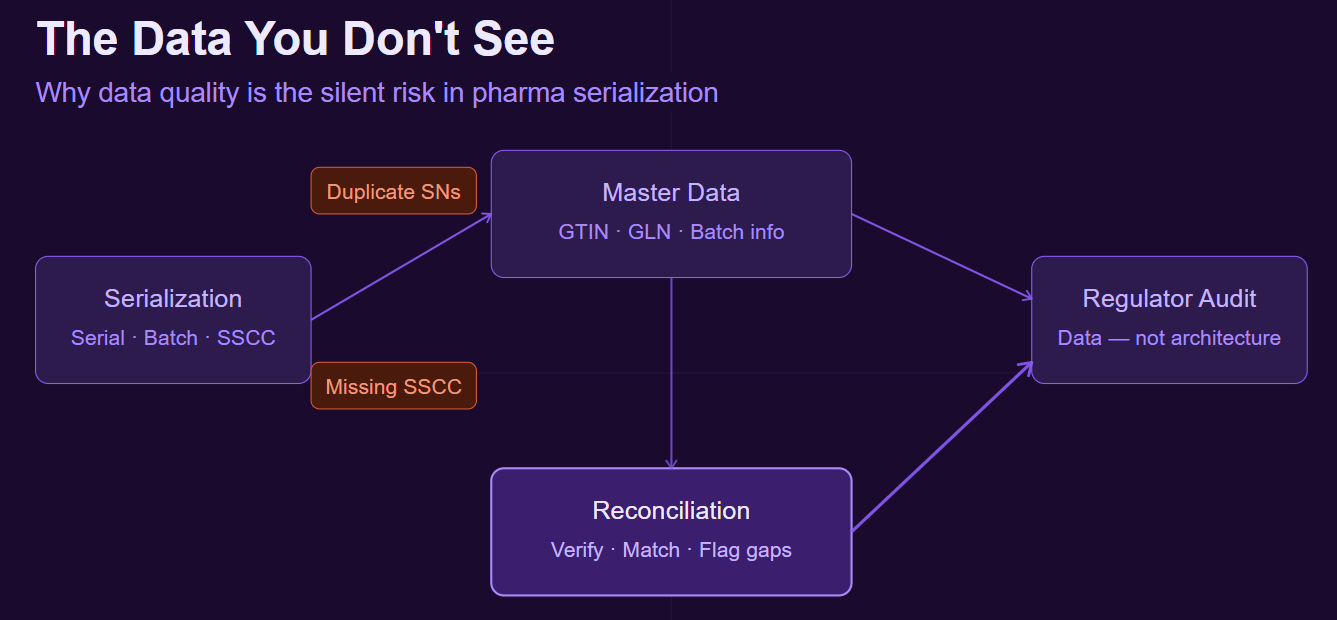
- Duplicate serial numbers: Generated correctly at the system level, but printed twice due to a line configuration error. Both exist in the database. Only one is physically on a product. The regulator sees both.
- Broken aggregation hierarchy: A carton gets re-packed manually on the warehouse floor without a system update. The system still shows it inside the original shipper. The physical reality and the digital record are no longer the same.
- Phantom SSCC codes: Pallet labels printed but never scanned into the system due to a scanner failure. The code exists on the label, nowhere in the database. Any downstream verification fails silently.
The three pillars that prevent it
Master data governance: Before a single serial number is generated, the GTIN, batch details, expiry, and GLN must be clean, consistent, and validated. Bad master data corrupts every event that follows.
Barcode verification: Every printed label must be verified at the point of print. Not sampled. Not spot-checked. Every label, every time. A label that cannot be read by a scanner should never reach the packaging line.
Reconciliation checks: At the end of every production order, the system count must match the physical count. Every exception must be investigated and resolved before the batch is released. Reconciliation is not a reporting step, it is a quality gate.
The principle that matters
Regulators don't audit your system architecture. They audit your data. And when the data doesn't hold up, the architecture doesn't matter.
Clean data is not a consequence of a good system. It is a discipline you build into every step of the process, from master data setup to physical verification to post-production reconciliation.
Clean data or clean architecture? In pharma serialization, you need both.
Prepared by: Ahmed Gamal - Engineering Director & Solutions Architect Origin Technology
Attachments
- Screenshot 2026-06-23 211918.png 71.7 KB