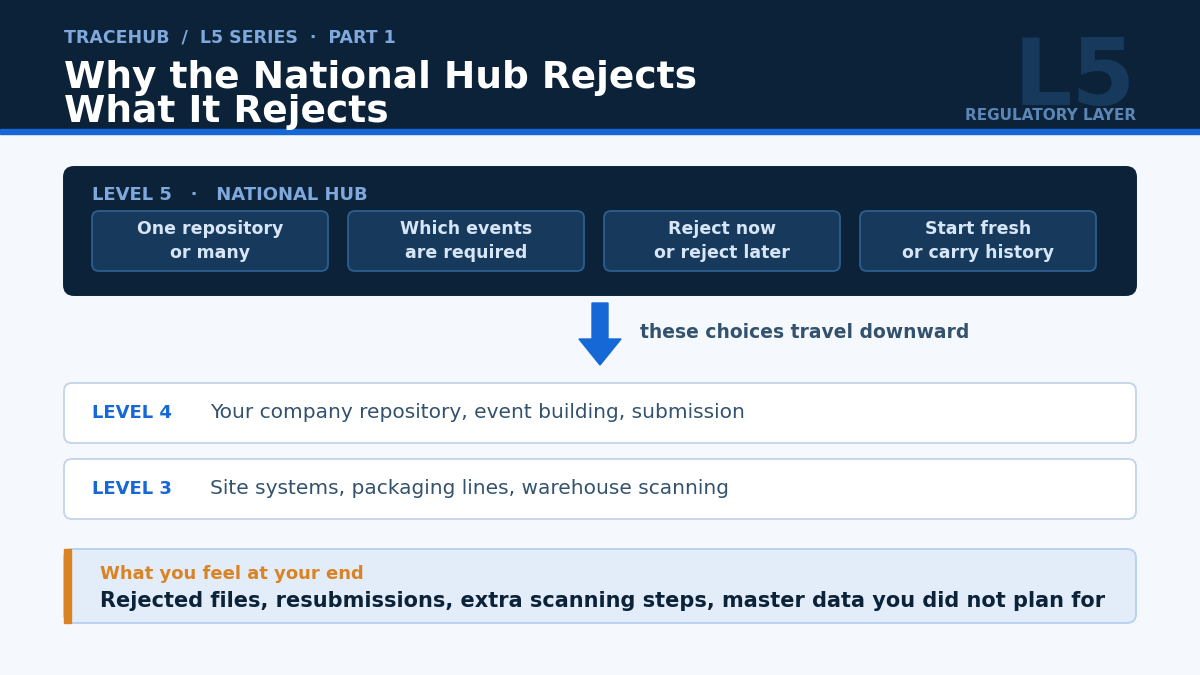
Why the National Hub Rejects What It Rejects >> L5 Series, Part 1
Read the guideline like an architect, not like a checklist. When a new country publishes its rules, the useful questions are not about field lengths. They are these four. Who holds the data. How far down the chain do I have to report. When do I find out I was wrong. And what happens to the stock I already have. If you can answer those four before you start scoping, you will size the project correctly. If you cannot, you will find the answers later, and they will cost more.
You send your first file to the national hub. It comes back rejected.
You check the serial numbers. They are fine. You check the GTIN. It is registered. You check the file format against the guideline, line by line, and everything matches. So you open a ticket, and you wait, and somewhere in that waiting you start to wonder if the problem is you.
Usually it is not you.
The reason your file came back is that somebody sat in a room two or three years ago and made a decision about how the national system would be built. That decision is now inside the code. You are meeting it for the first time today, at the worst possible moment, with a shipment sitting in a warehouse.
This article is about that room.
What L5 actually is
Most people in this industry know the levels from the factory side. Level 1 is the sensor. Level 2 is the machine. Level 3 is the line and site system. Level 4 is the company repository that talks to the outside world.
Level 5 is the national system. The regulator's platform. Tatmeen, RSD, EPTTS, NHRA, ITS, and the rest of them.
Here is what most people miss. L5 is not one agreed design that every country copied. Each country built its own, for its own reasons, with its own budget and its own timeline and its own idea of what problem it was solving. Two hubs can both call themselves track and trace and behave nothing alike.
We want to walk through four choices that get made at L5. You did not make them. You just live with them.
Choice one: one repository or many
Some countries decided the national hub would hold everything. Every serial number, every event, all in one place, owned by the authority.
Other countries decided the opposite. The data stays with the companies, and the hub only sees what it needs to see, or only steps in when there is a question to answer.
Both are defensible. A central repository gives the regulator a full picture and makes recalls and market analysis straightforward. It also costs a lot to build and run, and it makes the authority responsible for storing commercially sensitive data. A distributed model is cheaper for the state and easier on industry, but the regulator has less visibility and has to trust that everyone is keeping their records properly.
What it means for you. In a central model, your L4 becomes a pipe. Your job is to push clean data upward, all the time, and the hub is the source of truth. In a distributed model, your own repository is the source of truth, and you need to be able to answer a question from the authority years later. Those are two different systems, two different storage plans, and two different retention policies.
Choice two: which events the hub asks for
This is the one that quietly decides your project cost.
Some hubs want commissioning only. Tell us the serial numbers exist and which product they belong to. That is it.
Some want commissioning plus aggregation, so they can see the parent and child relationship between the pack, the case, and the pallet.
Some want the full chain. Commissioning, aggregation, shipping, receiving, all the way to the pharmacy scan when the product reaches the patient.
The regulator picking the third option is usually not asking for more work out of enthusiasm. They are often trying to solve a specific national problem. Leakage of subsidised medicine. Re-export of product that was never meant to leave. Pricing at the point of sale. The wider the reporting scope, the more of those problems the data can answer.
What it means for you. Commissioning only is a software project. Full chain reporting is an operations project. It changes your packaging lines, your warehouse layout, your picking process, and the number of people scanning things every day. Many companies budget for the first and then discover they signed up for the second.
Choice three: reject now or reject later
When you submit, does the hub check your file and answer immediately, or does it accept the file and validate it in the background?
Immediate validation is harder to build and needs more infrastructure, because the system has to be available and fast at all times. But you know within seconds if something is wrong.
Background validation is easier on the hub and handles big files better. The cost lands on you. You submit, you assume it went through, and three days later you learn that a batch failed on a field you did not check.
What it means for you. If your hub validates in the background, you cannot treat submission as the end of the process. You need to poll for status, you need somebody who owns that queue, and you need a rule for what happens to product that has already moved while the answer was still pending.
Choice four: start fresh or carry history
At go live, does the country say every pack from this date forward must be serialized, or does it say everything currently in the market must be brought in?
Starting fresh is much simpler. It is also slower, because the old stock stays in the chain for as long as its shelf life allows, and during that period pharmacies are handling two kinds of product at once.
Bringing in existing stock closes the gap faster and creates a real headache for distributors, who suddenly have to label and report inventory that arrived long before anyone asked them to.
What it means for you. This single decision determines whether your go live is a line configuration change or a full inventory exercise across every warehouse you own.
So what do you do with this
Read the guideline like an architect, not like a checklist.
When a new country publishes its rules, the useful questions are not about field lengths. They are these four. Who holds the data. How far down the chain do I have to report. When do I find out I was wrong. And what happens to the stock I already have.
If you can answer those four before you start scoping, you will size the project correctly. If you cannot, you will find the answers later, and they will cost more.
What is coming in this series
This was the view from outside. Over the next parts we want to go inside, and look at how these systems are actually built, and why the same requirement can be easy in one country and painful in another.
Next: what a national hub does in the first second after your file arrives.