The framework clearly outlines how serialization and traceability will be implemented across all supply-chain stakeholders,from manufacturers to pharmacies creating a foundation for full product visibility and stronger protection against counterfeit medicines.
Key highlights of Phase 1 implementation:
 Manufacturers
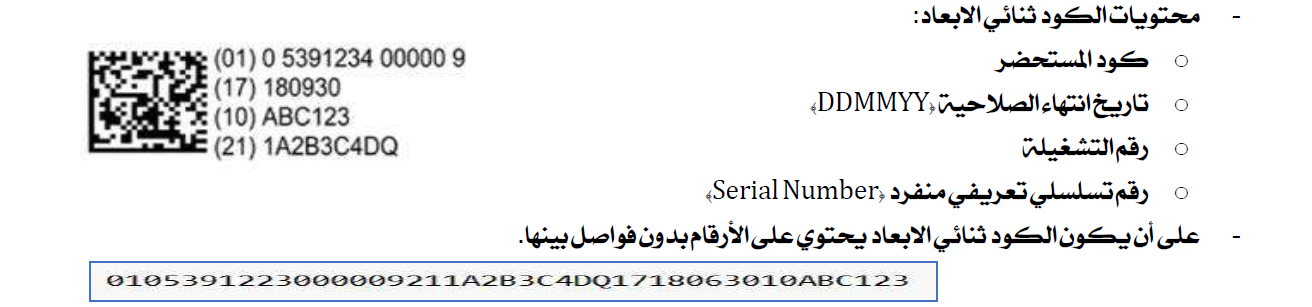
- All registered and marketed human and biological medicines must carry a 2D Data Matrix code on the secondary packaging.
- The code must include:
- • Product identifier (GTIN)
- • Unique serial number
- • Batch number
- • Expiry date (DDMMYY)
- Companies must print the same data mentioned above in addition to the manufacturing date on the outer packaging.
- Packaging lines must support printing and verification of serialization codes.
- Companies must operate a digital inventory management system.
- A separate location code (GLN) is required for each manufacturing site and warehouse.
- Aggregation must be implemented at higher packaging levels such as shrink bundles and cartons( Pallets not mentioned).
 Importers
- All registered and marketed human and biological medicines must carry a 2D Data Matrix code on the secondary packaging.
- The code must include:
- • Product identifier (GTIN)
- • Unique serial number
- • Batch number
- • Expiry date (DDMMYY)
- Companies must print the same data mentioned above in addition to the manufacturing date on the outer packaging.
- Imported products must be serialized before shipment to Egypt (temporary allowance exists for printing inside Egypt through licensed facilities).
- When importing from countries that do not follow global coding standards, the importer is responsible for ensuring compliance with EDA requirements before market circulation.
- Aggregation must be applied up to all shipment levels (shrink,carton,pallet).
- Manufacturers must provide importers with electronic data before shipment, including:
- • Serialized product lists at unit level
- • Aggregation hierarchy data
- • Shipping unit identification codes (sscc)
- Importers must upload this information to the national system using CSV, JSON, or XML files.
 Distributors and Pharmaceutical Warehouses
- The internal warehouse system should be compatible with the national traceability platform is required.
- All inbound shipments must be recorded in the system within 48 hours of receipt.
- Each receiving event must be linked to the aggregation code (SSCC) and the source location code (GLN).
- Codes must be verified to ensure serialization validity.
- Aggregation hierarchy must be validated before any shipment or disaggregation activity.
- Shipping events must be recorded in real time for downstream partners such as pharmacies and hospitals.
- Each warehouse must have its own location identifier (GLN).
 Community and Private Pharmacies
- Pharmacies must operate with system integrated with the national traceability platform.
- All receiving operations from distributors must be recorded and verified.
- Serialized codes must be validated before dispensing.
- Dispensing events must be recorded in real time, including location, date, and time.
- In case of partial dispensing from a package, the 2D code must continue to be scanned until the last unit in the package is dispensed.
Important compliance point:
Any package containing a code that cannot be verified must immediately be quarantined and reported to the Egyptian Drug Authority.